
Southern California’s Leading Paging & Intercom Systems Provider
AlphaComm Inc. designs, installs, and maintains commercial paging and intercom systems for warehouses, schools, medical centers, office buildings, and industrial facilities across Southern California. Headquartered in Corona and licensed as a C7 low-voltage and C10 electrical contractor, we build both modern IP-based systems and traditional 70V analog systems — and integrate either one with your existing phone system, access control, master clocks, and emergency notification platform.
Every project starts the same way: a free on-site sound-level test and coverage plan, so the system is sized to your ceiling height and ambient noise rather than a square-footage estimate. You get a fixed written quote, documented zone maps, and a system that passes fire marshal inspection the first time.
Our Paging & Intercom Services
Commercial Paging Systems — Overhead, Zone, and Emergency
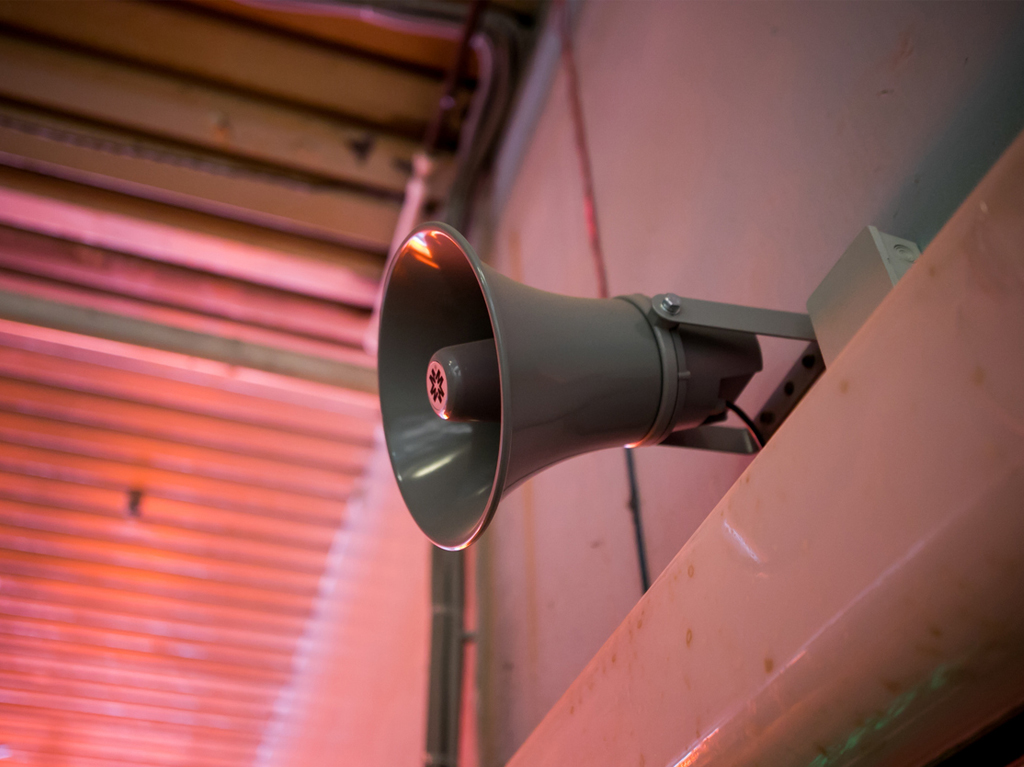
- 70V analog or fully digital IP overhead paging using high-efficiency horn and ceiling speakers
- Zone paging so you can address “Warehouse Only,” “Office Staff,” or “Entire Campus” from one button
- Emergency and mass-notification paging that overrides local volume controls and broadcasts critical alerts instantly
- Scheduled bell and tone packages for schools and manufacturing — class changes, shift signals, break tones, with holiday and early-release exceptions handled automatically
- Weatherproof outdoor horns and visual strobes for loading docks, yards, and parking areas
Intercom & Entry Communication
- Door and gate intercom with two-way audio, video, and remote unlock from a desk phone or mobile app
- Classroom call-back intercom that lets staff initiate a private two-way conversation with the front office
- Talk-back speakers in warehouses and shipping offices for confirmation without walking the floor
- Nurse call and staff assist integration for medical and senior care facilities
- Clean-room, drive-through, and window intercom for environments where a barrier separates staff and visitors
Phone System & VoIP Paging Integration
Use the phones you already have instead of buying a parallel system.
- Integration with Cisco, Microsoft Teams, RingCentral, 8×8, Zoom Phone, Avaya, Mitel, and most cloud or on-premise PBX platforms
- Dial-by-extension or speed-dial paging from any desk phone, softphone, or mobile app
- SIP-based IP speakers and paging gateways that turn your VoIP platform into a full paging system
- Multicast paging with IGMP snooping and cross-VLAN routing configured so announcements don’t load your data network
- SIP-to-70V gateways that add IP control to existing analog speakers without replacing them
Design, Installation & Ongoing Support
- Free on-site sound-level testing and written coverage plan before any quote
- Fire marshal plan submittal, permitting, and inspection coordination
- Background music integration from streaming or local sources
- Battery backup and failover for life-safety compliance
- As-built documentation, zone maps, and end-user training at handoff
- Scheduled maintenance, NFPA 72 annual inspection and testing, and 24/7 service response
IP Paging vs. 70V Paging: Which Does Your Facility Need?
The right answer depends on how many buildings you have, whether you run VoIP phones, and how much you expect to expand. Here’s how the two compare:
| Feature | 70V Analog | IP / SIP |
|---|---|---|
| Wiring | Dedicated speaker cable, daisy-chained | Existing Cat6 network cabling, PoE |
| Zone control | Split at the amplifier; adding zones means rewiring | Every endpoint individually addressable in software |
| Multi-building | Requires an amplifier per building | Native across sites over the WAN |
| Phone integration | Contact closure or loop-start interface only | Direct SIP registration; dial-to-page |
| Bells, clocks, lockdown | Requires separate controllers | Built in and schedulable |
| Up-front cost | Lower | Higher — adds controller and endpoint licensing |
| Best fit | Single building, 2–3 zones, no integration needs | Multi-site, VoIP phones, schools, growing facilities |
These aren’t mutually exclusive. If you have working analog speakers and amplifiers, a SIP-to-70V gateway adds IP control and phone integration without pulling new speaker wire — usually the most cost-effective path for an existing facility.
Paging Systems by Facility Type
Warehouses & Distribution Centers
Coverage in a distribution center is set by ceiling height and ambient noise, not floor area. Above roughly 20 feet, ceiling speakers lose intelligibility, so 30- to 40-foot facilities need directional horn speakers aimed down the length of rack aisles. Racking creates acoustic shadows — a horn mounted perpendicular to the aisles leaves dead zones no matter how many you add. We design around aisle alignment, dock and yard coverage, and the 70–80 dBA ambient noise typical of an active floor.
Schools & Campuses
K–12 and community college projects go through Division of the State Architect (DSA) plan review rather than the local building department, and Group E occupancies carry specific emergency voice/alarm requirements under CBC and CFC Section 907. We build systems that combine automated bell scheduling, classroom call-back intercom, one-touch lockdown across every classroom, hallway, gym, and field, and DSA-compliant emergency voice evacuation — on a single platform rather than four disconnected ones.
Healthcare & Medical Centers
Hospitals and clinics need overhead paging that coexists with nurse call, code alerts, and HIPAA-conscious operations. That means discreet zone control so a code page doesn’t broadcast into patient rooms unnecessarily, prioritized emergency override, and integration with existing nurse call and staff communication platforms.
Manufacturing & Industrial
Production floors need audio that cuts through machinery, plus shift signaling, andon notification, and hearing-protection-compatible visual alerting. We pair high-SPL horns with strobes where sound alone can’t be relied on, and tie the system into existing production and safety triggers.
Office Buildings & Multi-Tenant Properties
Multi-floor and multi-tenant properties need clean zone separation so one tenant’s announcement doesn’t reach another’s suite, plus building-wide emergency override that satisfies the fire marshal. Background music integration and reception paging typically run on the same infrastructure.
California Code Compliance
Paging becomes a code-governed system the moment it doubles as emergency notification. Section 907 of the California Building Code and California Fire Code requires an emergency voice/alarm communication system (EV/ACS) in Group E occupancies and certain Group A assembly occupancies. In Riverside County, an EV/ACS is required when the approved occupant load exceeds 50, when there is more than one classroom, or when day care is provided and a fire alarm system is installed.
Equipment must carry California State Fire Marshal (CSFM) listing per CFC 907.1.3, paging zones must be configured per CFC 907.5.2.2, and any system integrated with fire alarm requires plan check and final inspection before sign-off. Requirements vary by authority having jurisdiction — Riverside County, San Bernardino County, Orange County, and the City of San Diego each publish their own standards and permit processes.
We confirm the applicable requirements with your AHJ during the site survey, before design, rather than discovering them at inspection. Our work follows NFPA 72, NEC, and TIA/EIA standards throughout.
Why Facilities Choose AlphaComm
- One vendor for the whole stack. Paging, intercom, structured cabling, VoIP integration, and fire alarm tie-in handled in-house — no coordinating three trades who each blame the other.
- Designed by measurement, not estimate. Free on-site sound-level testing and a written coverage plan before you see a price.
- Permit-ready. We handle fire marshal submittal, plan check, and inspection coordination on life-safety-integrated systems.
- Professional-grade endpoints. Valcom, Viking, Algo, and CyberData — equipment with parts availability and firmware support a decade out.
- Built to expand. Start with five zones and scale without replacing head-end hardware.
- Local and long-established. Corona-based since 2008, with technicians throughout the region and 24/7 service response.
Licensed, Bonded & Insured
AlphaComm Inc. is a licensed C7 (Low Voltage) and C10 (Electrical) contractor headquartered in Corona, California. Our teams are Corning-certified and BICSI-trained, and we work to TIA/EIA, NEC, NFPA 72, and local permitting requirements across every jurisdiction we serve.
Southern California Service Area
We serve Riverside, San Bernardino, Orange, Los Angeles, and San Diego counties, including Riverside, Corona, Anaheim, Irvine, Ontario, Rancho Cucamonga, Los Angeles, and San Diego — plus multi-site national rollouts for regional clients.
Explore our paging & intercom services in
Riverside | Anaheim | Irvine | Ontario | Rancho Cucamonga | Los Angeles | San Diego
Industries We Serve
- Warehouses & Distribution Centers
- Education & University Campuses
- Healthcare & Medical Centers
- Manufacturing & Industrial Facilities
- Commercial Office Buildings
- Government & Municipal Projects
- Data Centers & Colocation Facilities
- Hospitality & Large Venues
Paging & Intercom System FAQs
Answers to the questions facility managers, IT directors, and school administrators ask us most often before starting a paging or intercom project.
How much does a commercial paging system cost?
Commercial paging system cost is driven by four things: how many speakers full coverage requires, how much amplifier capacity is needed to drive them, what equipment it takes to install at height, and whether the system also handles bell scheduling, intercom, or emergency notification. A single-zone office and a high-bay distribution center are different projects by an order of magnitude, which is why we don’t quote from square footage or over the phone.
What moves the number most:
- Speaker count and type. Determined by ambient noise and ceiling height, not floor area. High-bay facilities need directional horns rather than ceiling speakers, and more of them than most people expect.
- Amplifier and head-end capacity. Speaker count drives amplifier sizing, and larger systems need multiple amplifiers, zone controllers, and backup power.
- Access equipment and installation labor. Mounting horns at 35 feet means scissor lifts or boom lifts, fall protection, and support hardware. On large warehouses this is a significant share of the total, and it’s the line item most estimates leave out.
- Additional systems. Bell and tone scheduling, classroom intercom, master clock sync, and background music each add head-end equipment.
- Life-safety integration. Tying into fire alarm requires CSFM-listed equipment, fire marshal plan review, permits, and inspection.
- Retrofit vs. new construction. Existing conduit and reusable speaker wire lower the number substantially. Occupied buildings requiring after-hours work raise it.
How we quote
Every project starts with a free on-site consultation. We walk the facility, run sound-level testing with your operation running normally, and identify ceiling heights, obstructions, existing infrastructure, and access constraints. That produces a written coverage plan showing speaker placement and zone layout.
From that plan you get a fixed written quote — equipment, labor, lift and access costs, permitting, and commissioning, itemized.
The consultation and coverage plan carry no cost and no obligation. If you’re building a budget for a future fiscal year, we can provide the plan and quote for planning purposes without a commitment to proceed.
What is the difference between IP paging and 70V paging?
IP paging and traditional 70V paging differ mainly in how audio is distributed and how the system is managed. A 70V paging system uses centralized amplifiers and speaker wiring, making it a reliable and cost-effective option for distributing announcements across many speakers. IP paging uses a facility’s data network and can provide more flexible zoning, centralized management, VoIP integration, system monitoring, and other advanced features.
The right choice depends on your facility’s existing wiring and network infrastructure, size, communication needs, budget, and plans for future expansion. Hybrid systems can also combine existing 70V speakers with newer IP-based paging technology.
For a more detailed comparison, read our guide to IP paging vs. 70V paging systems.
Can I page overhead through my existing phone system?
Yes, many VoIP phone systems can connect to overhead paging through a compatible SIP paging adapter or IP speakers. An adapter may let you retain existing analog speakers and an amplifier. The setup depends on your phone platform, equipment compatibility, network, and paging zones.
Learn how to add overhead paging to your VoIP phone system.
Does my building need an emergency voice/alarm communication system in California?
It depends on your occupancy classification and occupant load. Section 907 of the California Building Code and California Fire Code requires an emergency voice/alarm communication system (EV/ACS) in Group E occupancies and certain Group A assembly occupancies. In Riverside County, an EV/ACS is required when the approved occupant load exceeds 50, when there is more than one classroom, or when day care is provided and a fire alarm system is installed.
An EV/ACS is not the same thing as a general paging system. It is a dedicated, code-governed system in which any fire detector, waterflow device, or manual pull station automatically initiates an alert tone followed by prerecorded or live voice evacuation instructions, with manual live-voice override capability. Equipment must carry California State Fire Marshal (CSFM) listing per CFC 907.1.3, and buildings with EV/ACS must be configured with defined paging zones per CFC 907.5.2.2.
Requirements vary by authority having jurisdiction. Riverside County, San Bernardino County, Orange County, and the City of San Diego each publish their own standards and permit processes, and K-12 and community college projects go through Division of the State Architect (DSA) plan review rather than the local building department. We confirm the applicable requirements with your AHJ during the site survey, before design.
How many speakers does a warehouse paging system need?
The number depends on the warehouse’s dimensions, background noise, mounting height, rack layout, and each speaker’s usable coverage. Square footage alone cannot establish the right count. A site survey and coverage plan help identify suitable speaker types, placement, and paging zones.
Learn more about how many speakers a warehouse paging system needs.
How long does a paging system installation take?
A small office or retail installation takes 1–2 days. A mid-size warehouse or multi-zone office building takes 3–7 days. A multi-building campus or any system integrated with fire alarm takes 2–6 weeks, with most of that time spent on plan review and inspection rather than field work.
The permitting path is the biggest schedule variable. A standalone paging system usually installs on your timeline. A system tied into life safety requires fire marshal plan check and a final inspection before it can be signed off, and that queue is outside any contractor’s control.
For occupied facilities we schedule after-hours and weekend work, and in warehouses we sequence around shift changes and peak season. Schools are typically done over summer or winter break. You get a written schedule with milestone dates after the site survey — not a range.
What maintenance does a paging system require?
A standalone paging system needs a quarterly functional check of each zone, amplifier, and backup battery, plus an annual speaker and connection inspection. If your system also serves as an emergency voice/alarm communication system, NFPA 72 requires documented annual inspection and testing, including battery load testing — that testing is a code obligation, not a recommendation. Annual maintenance typically runs $300–$5,000 depending on system size.
The failures we see most often are predictable: backup batteries reaching end of life at 3–5 years, water intrusion in outdoor horns, amplifiers running hot in unventilated IDF closets, and speaker taps quietly changed during a tenant improvement, leaving a zone too quiet to hear.
Documentation matters as much as the testing. Fire marshals, insurers, and compliance auditors ask for inspection records, and zone maps go stale fast in facilities that reconfigure space. We keep both current for every system we maintain.
Can school bells, intercoms, and lockdown announcements work together?
Yes, compatible systems can combine bell scheduling, classroom intercom, and campus-wide announcements. The design should address coverage, message priorities, accessibility, staff permissions, and backup power. Door locking and fire-alarm integration require separate compatibility and approval checks.
Read our California guide to school bell, intercom, and lockdown systems.
Get a Free Site Survey and Coverage Plan
Call AlphaComm Inc. at (951) 738-1771 or request your free consultation for a same-week site survey. We’ll walk your facility, run sound-level testing, and give you a written coverage plan and a fixed quote — before you commit to anything.
AlphaComm Inc.
Headquartered in Corona, California — serving Southern California since 2008
License #893300 (C7) | License #958793 (C10)
Corning Network of Preferred Installers | BICSI Corporate Member