
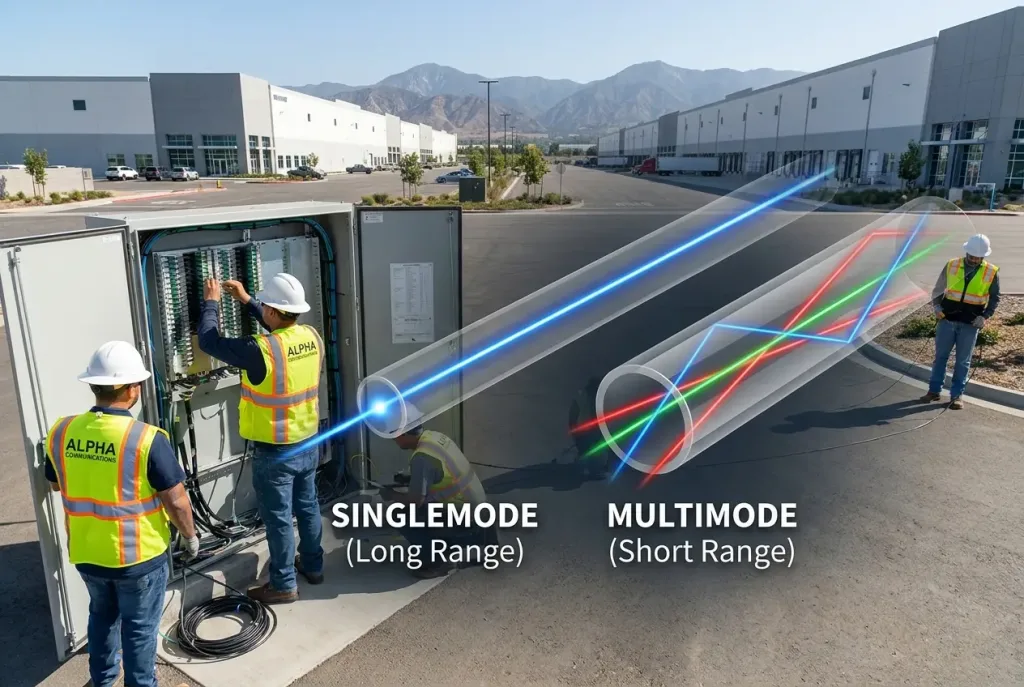
 Quick Answer: Singlemode fiber uses a small 9-micron core to carry light in a single path over long distances with minimal signal loss, while multimode fiber uses a larger 50-micron core that allows multiple light paths, making it ideal for shorter, high-speed connections within buildings or data centers.
Businesses across Southern California are investing heavily in high-speed infrastructure, from 100G networks to cloud-based systems. But many run into a frustrating bottleneck: the hardware is capable of incredible speeds, yet the network still lags. In many cases, the problem isn’t the equipment—it’s the wrong type of fiber.
From sprawling logistics centers in the Inland Empire to high-density tech hubs in San Diego, choosing between singlemode and multimode fiber is not just a technical decision—it’s a strategic one. The right choice can future-proof your network. The wrong one can cost you time, money, and performance.
The Physics of Light: Why Core Size Matters
The difference between singlemode and multimode fiber comes down to how light travels through the cable.
Singlemode fiber (OS2) has a very small core—about 9 microns in diameter. This allows light to travel in a single, straight path using a principle called total internal reflection. Because the signal does not bounce around, it avoids distortion and maintains strength over extremely long distances.
This makes singlemode ideal for:
- Long-distance runs between buildings
- Campus-wide connectivity
- Telecommunications infrastructure
Multimode fiber (OM3/OM4/OM5) has a much larger core—typically 50 microns. This allows multiple light signals (or “modes”) to travel simultaneously, similar to traffic moving through a wide tunnel instead of a narrow hallway.
However, those multiple signals begin to overlap and scatter over distance, creating what’s known as modal dispersion. This limits how far multimode fiber can effectively transmit data.
From a technical standpoint:
- Singlemode operates at wavelengths of 1310nm and 1550nm
- Multimode operates at 850nm and 1300nm
This difference plays a major role in performance, cost, and application.
Distance vs Bandwidth: The Decision Matrix
Choosing between singlemode and multimode fiber often comes down to distance and bandwidth requirements.
The “500-meter rule” is a helpful guideline. Multimode fiber performs extremely well for short distances—typically within a single building or campus floor. But once your network extends beyond that range, singlemode becomes the clear choice.
Multimode is ideal for:
- Internal office networks
- Server rooms and data centers
- High-speed connections under 500 meters
Singlemode is required for:
- Building-to-building connections
- Campus environments like those in Rancho Cucamonga
- Any long-distance or outdoor installation
In 2026, speed demands are evolving quickly:
- 10G and 40G networks are still common for multimode deployments
- 100G and 400G networks are pushing businesses toward singlemode
There is also growing interest in OM5 wideband multimode fiber, which supports Shortwave Wavelength Division Multiplexing (SWDM). This allows multiple wavelengths to travel simultaneously, extending the life and capacity of multimode systems—but still within limited distances.
The Economics of Fiber: CapEx vs OpEx
One of the biggest misconceptions in fiber optics is that multimode is always the cheaper option. The reality is more nuanced.
When comparing costs, you need to consider two components:
- Cable Cost: Singlemode (OS2) cable is often less expensive than high-grade multimode (OM4/OM5)
- Optics Cost: Singlemode transceivers use precision lasers, making them more expensive than the VCSEL-based optics used in multimode
This creates a trade-off:
- Multimode = lower upfront hardware cost
- Singlemode = lower long-term infrastructure cost
The real question is total cost of ownership.
For example, a company in San Diego might install OM4 fiber today to save money. But if they need to upgrade to 400G in just a few years, they may be forced to replace the entire system.
Singlemode, on the other hand, offers a future-proof solution that can scale with evolving technology—potentially saving significant costs over time.
Local Use Cases Across Southern California
Different industries across Southern California require different fiber solutions.
Scenario A: Inland Empire Logistics Hub
A large warehouse operation in the Inland Empire needs to connect multiple buildings across a wide campus. In this case, singlemode fiber is the only practical solution. It supports long-distance runs, outdoor environments, and high-capacity data transmission without signal degradation.
Scenario B: Orange County Creative Office
A digital agency in Orange County needs ultra-fast connectivity within a single office floor. Multimode fiber provides the best balance of speed and cost for this type of high-density, short-distance network.
Understanding your environment is key to making the right choice.
Installation Excellence with Alphacomm
At Alphacomm, Inc., proper installation is just as important as choosing the right fiber type. Our team uses precision fusion splicing to minimize signal loss and ensure long-term reliability.
Every installation is verified through OTDR testing, providing a full certification report to confirm performance standards. We also ensure compliance with TIA/EIA industry standards, giving Southern California businesses confidence in their network infrastructure.
Singlemode vs Multimode Fiber Comparison
| Metric | Singlemode (OS2) | Multimode (OM4/OM5) |
|---|---|---|
| Core Diameter | 9 Microns | 50 Microns |
| Light Source | Laser | VCSEL / LED |
| Max Distance (10G) | 40km+ | 400m – 550m |
| Best Local Use | Building-to-Building (Inland Empire) | Internal Data Center (San Diego) |
| Future Readiness | Up to 800G+ | Up to 100G (standard) |
Conclusion
Choosing between singlemode and multimode fiber is not just about today’s needs—it’s about building a network that supports your future growth. Whether you’re expanding across the Inland Empire or upgrading a data environment in San Diego, the right infrastructure makes all the difference.
Ready to optimize your network? Visit our Fiber Optics Services page to schedule a free consultation and site survey.